
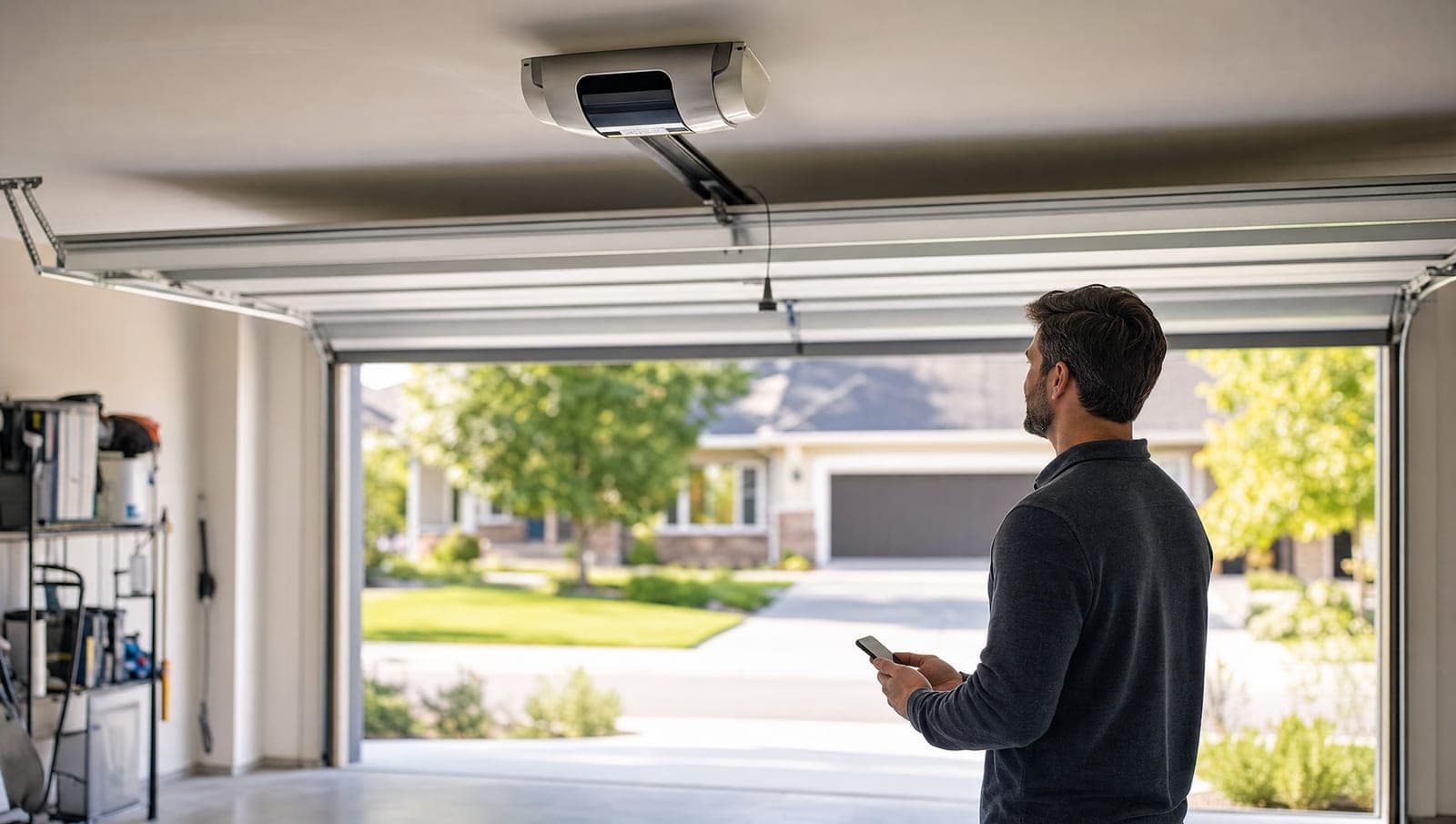
What a smart opener actually does for you
Most homeowners ask for a smart opener after the same moment: they're 20 minutes from home, can't remember if the door is shut, and there's no way to check. That single problem, knowing the door's status and being able to close it from anywhere, is the real reason to upgrade. Everything else is a bonus.
Here's what the smart features genuinely buy you in 2026, separated from the marketing:
- Open and close from your phone, plus a live open or closed status you can trust.
- Push alerts when the door moves, so you know if a kid left it up or someone opened it at 2 a.m.
- Scheduled and auto-close rules, like "close automatically at 10 p.m." or "close after the door has been open 15 minutes."
- Guest and delivery access, so a relative or a delivery driver can get in once without you handing over a remote or a code.
- Voice control through Alexa or Google Assistant, and HomeKit on a few specific controllers (more on that below).
- Camera integration. Newer premium units like the LiftMaster Secure View and Chamberlain Secure View build a camera right into the opener head, so the video and the door live in one app.
If none of that solves a real annoyance for you, you probably don't need to spend the money. If two or three of them do, an upgrade pays for itself in saved worry pretty quickly.
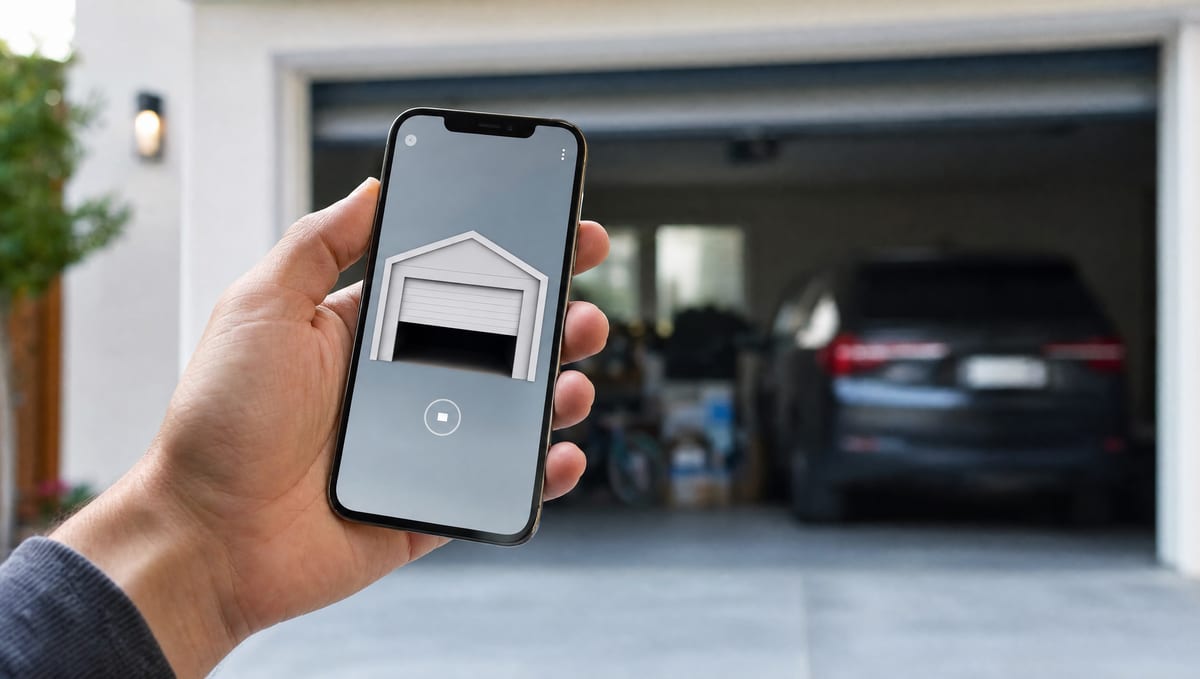
Drive types and noise: pick this first
Before you think about apps, pick the right mechanical drive. This part hasn't changed in 2026 and it matters more than any smart feature, especially in a home with a bedroom over the garage.
- Belt-drive is the quietest by a wide margin. A rubber belt instead of a metal chain means almost no rattle. This is the one to get for an attached garage with living space above it.
- Chain-drive is the cheapest and the most durable, but it's noticeably louder. Fine for a detached garage or a shop.
- Screw-drive sits in the middle on both price and noise.
- Direct-drive and jackshaft (wall-mount) units mount on the wall beside the door instead of on the ceiling. They're the answer for low headroom, a finished ceiling, or a tall door where there's no room for a rail. A jackshaft also frees up your whole ceiling.
If your garage has limited headroom, a tech can tell you fast whether your door's spring system is a good match for a wall-mount unit. It's worth checking before you buy, because not every door setup supports one cleanly. Our opener replacement visits start with exactly that kind of assessment.
The ecosystems, honestly
LiftMaster and Chamberlain (myQ)
These are both Chamberlain Group brands and both run on the myQ app. Their rolling-code security is Security+ 2.0, marketed as one-time-use codes drawn from billions of possibilities, and a newer Security+ 3.0 generation started rolling out around late 2025. Solid hardware, reliable app. The catch is integrations, covered below.
Good current examples: the Chamberlain B4505T, an ultra-quiet Wi-Fi belt-drive with myQ built in, is the mainstream pick. The LiftMaster Secure View 87504-267 adds a built-in camera, battery backup, and corner-to-corner LED lighting if you want the premium camera tier.
Genie Aladdin Connect
Genie sells Aladdin Connect both as a built-in feature on its smart openers and as a retrofit kit for many existing openers. It handles up to around 20 doors and users, supports scheduled and auto-close rules and guest users, and works with Alexa and Google Assistant. Native Apple HomeKit is not part of the pitch.
The Apple HomeKit problem
This is the single biggest gotcha, so read it twice if you're an iPhone household. myQ does not support Apple HomeKit. In October 2023, Chamberlain Group blocked unofficial third-party integrations. Official Alexa and Google control through myQ now generally sits behind a paid "Works with myQ" tier or a paid bridge, so even basic voice control may cost you. Pricing on those tiers varies, so confirm it with the vendor before you assume a feature is free.
If you run an Apple Home household and want the garage in your Home app, do not buy a stock myQ opener expecting it to just work. Plan the retrofit route on purpose, or you'll be disappointed.
Retrofit a controller vs buying a new smart opener
You usually do not need a whole new opener to get smart features. If your existing opener runs fine and isn't ancient, a retrofit controller is the cheaper, faster path.
- Meross MSG200 (roughly $30 to $55): supports Matter, so it pairs with Apple Home, Google Home, and Alexa. The default budget pick for most homes that want HomeKit-style control.
- ratgdo / ratgdo32 and the Konnected GDO blaQ (about $40 to $50): open-source-based boards with native HomeKit and fully local control, no subscription. They can even interface with Security+ 2.0 openers. Best choice for Apple users who want everything to run locally.
- Tailwind iQ3 (about $50 to $80): well-regarded, subscription-free, works with Alexa, Google, and SmartThings. Note it does not support HomeKit, so skip it if Apple Home is the goal.
- Chamberlain myQ Smart Garage Hub (about $28 to $35): the cheapest, but it locks you into the myQ app with limited free third-party voice control.
- iSmartGate Pro (roughly $99 to $130): higher-end with broad integration, including HomeKit.
One important warning before you buy any retrofit: the newer Security+ 3.0 protocol on later 2025 and 2026 openers can block third-party controllers from triggering the door over the wire. On the newest LiftMaster and Chamberlain units, myQ may be the only thing that works. Check your opener's age and protocol first, and verify the specific kit supports it. When in doubt, a quick call to a tech saves you a return.
Where Matter and Thread stand for garage in 2026
Be careful with the Matter hype here. As of mid-2026, the Matter specification still has no dedicated garage-door device type. Controllers like Meross work with Apple, Google, and Alexa by presenting the door as a generic Matter device, not through a finished, universal "Matter garage" standard. It works well in practice, but anyone selling you a complete Matter garage spec is overstating where the standard actually is.
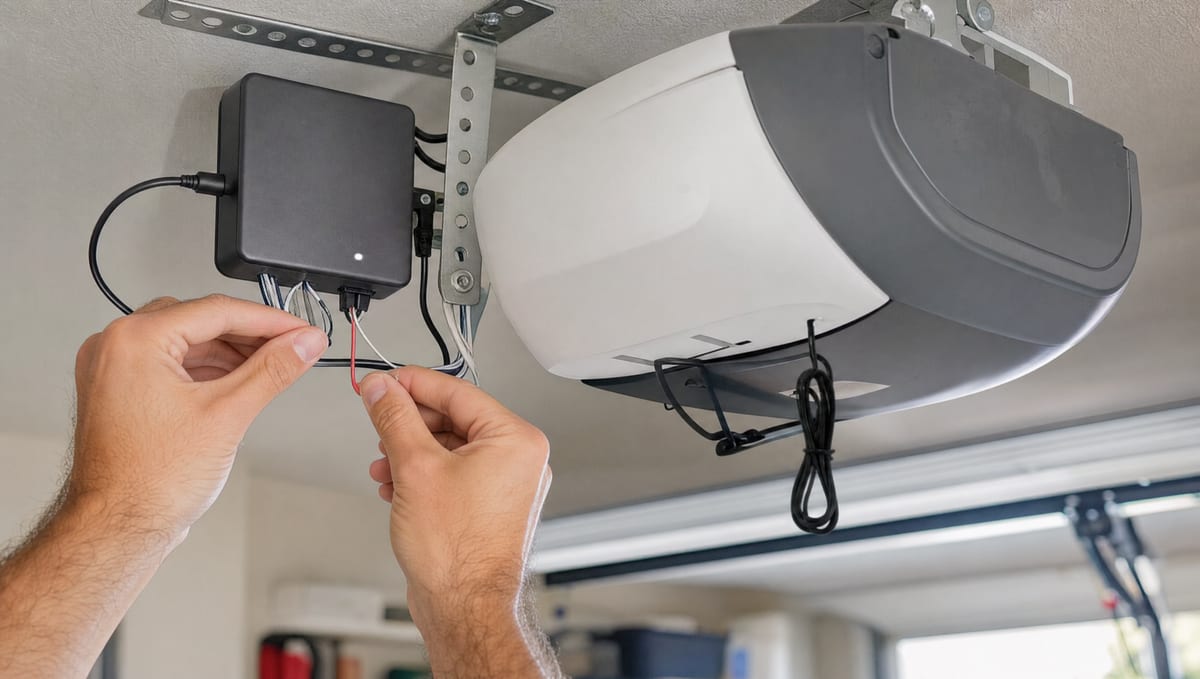
Security: what to insist on
A garage door is a real entry point to your house, so treat the security like it matters.
- Insist on rolling-code (Security+ 2.0 or newer), not an old fixed-code remote that can be captured and replayed.
- Turn on two-factor authentication on whatever app account controls the door.
- Avoid cheap unbranded clone remotes and controllers. They can weaken rolling-code protection or quietly send data to servers you can't see.
- Value local control. Subscription-free options like ratgdo, Konnected, or Meross over Matter keep working even if a vendor's cloud goes down.
Realistic costs
Treat every figure here as a range to confirm with a quote, not a fixed price. They shift by model, retailer, and what your garage needs.
- Retrofit controllers: roughly $30 to $130 depending on the kit.
- A new belt-drive opener unit: roughly $350 to $550. Smart features add about $50 to $200 over a basic model.
- Total installed cost for a new opener: commonly $375 to $900, depending on options.
- Professional installation: usually about 2 to 3 hours, often quoted around $65 to $85 per hour.
- Extras: header reinforcement roughly $50 to $150, a new electrical outlet roughly $100 to $250 if none exists near the opener.
A like-for-like opener swap usually needs no permit, but town rules vary, especially if new wiring is involved. Confirm with your municipality if an electrician has to add an outlet. If you'd rather hand the whole thing off, our new installation service covers unit selection, mounting, and setup in one visit.
So, should you upgrade?
A quick verdict, since that's what you came for.
- Upgrade if you forget to close the door, want auto-close at night, need to let in deliveries or guests remotely, or your current opener is loud and your bedroom sits over the garage (get belt-drive).
- Retrofit, don't replace, if your opener works fine and isn't a brand-new Security+ 3.0 unit. Match the controller to your phone ecosystem first.
- Skip it if your opener is quiet, reliable, and none of the smart features solve an actual problem you have. There's no shame in a dumb door that just works.
Frequently asked questions
Do I need a whole new opener, or can I make my existing one smart?
In most cases you can keep your opener and add a retrofit controller for $30 to $130. You only need a new opener if yours is failing, very old, or you specifically want a built-in camera model. Confirm your opener's protocol first, since the newest Security+ 3.0 units can block some retrofits.
Will a smart opener work with Apple HomeKit?
Stock myQ openers (LiftMaster, Chamberlain) do not support HomeKit. To get the garage into Apple Home, use a HomeKit-friendly retrofit such as ratgdo or the Konnected GDO blaQ for local control, Meross via Matter, or iSmartGate Pro. Tailwind and Genie Aladdin Connect do not do HomeKit.
Is myQ free, or do I pay a subscription for Alexa and Google?
The app itself is free for basic open, close, and status. Official Alexa or Google voice control through myQ generally requires a paid "Works with myQ" tier or a paid bridge. Pricing changes, so check the current vendor terms before counting on free voice control.
What does Matter mean for garage doors, and can I use it yet?
You can use Matter-based controllers like Meross today, and they pair cleanly with Apple, Google, and Alexa. Just know the Matter spec has no dedicated garage-door type yet as of mid-2026, so the door shows up as a generic Matter device. It works, but it isn't a finished universal garage standard.
Which drive type is quietest if I have a bedroom over the garage?
Belt-drive, clearly. The rubber belt nearly eliminates the rattle you get from a chain. For low-headroom garages, a wall-mount jackshaft unit is also quiet and frees up ceiling space, though it depends on your door's spring setup.
Can I let a delivery driver or guest in without giving them my code?
Yes. Most smart platforms support guest access or one-time entry, and myQ has worked with package-delivery programs. You grant temporary access from the app and revoke it whenever you want, so nobody keeps a permanent way in.
Get it installed right
If you'd rather have a pro spec the correct drive type, match the right smart controller to your phone, and mount it cleanly the first time, we can help. Garage Door USA offers same-day and emergency service, and our techs handle both new smart openers and retrofits onto existing units. Call (201) 500-3377 any time, 24/7, or read more about our opener replacement options to plan your upgrade.